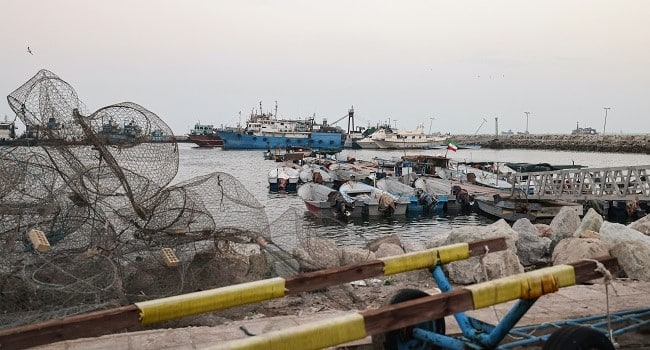








Boats are seen anchored at the Five-Step local fishing harbour in the port city of Bandar Abbas in southern Iran on September 5, 2026. (Photo by Atta KENARE / AFP)
Iran said on Sunday that its forces had attacked a US naval drone attempting to enter the Strait of Hormuz, hours after targeting oil tankers in retaliation for American strikes on three vessels.
The latest escalation comes amid a six-month conflict between Tehran and Washington, with both sides maintaining pressure on the strategically important waterway.
Iran has continued to restrict access through the Strait of Hormuz, while the United States maintains a counter-blockade of Iranian ports and has imposed additional sanctions on entities with financial ties to Tehran in an effort to pressure the Iranian government.
The Islamic Revolutionary Guard Corps (IRGC), Iran’s elite military force, said its naval forces had attacked an American unmanned surface vessel that was attempting to enter the strait.
The IRGC said the operation was carried out in response to earlier US strikes and warned ships against using what it described as unauthorised routes through the waterway.
Hours earlier, the Guards said their naval forces had targeted three oil tankers using an unauthorised route through the Strait of Hormuz, as well as three vessels it described as being affiliated with the United States in other areas.
The claims followed an operation announced by US Central Command (CENTCOM), which oversees American military activities in the region.
CENTCOM said it had struck three tankers linked to the IRGC after accusing the Iranian military force of firing unsuccessfully at US warships.
“Following Iran’s failed attacks, CENTCOM permanently disabled the IRGC crude oil carriers M/T Downy off the coast of Kharg Island and M/T Stark 1 near Jask,” the command said.
It added that US forces had also destroyed the unladen crude oil carrier M/T Kylo in the Gulf of Oman after directing its crew to abandon the vessel.
CENTCOM said the three ships were part of a multibillion-dollar “shadow network” used to finance the IRGC and its regional allies.
Footage released by the US military showed large explosions and flames rising from the vessels after they were struck.
‘Higher economic cost’
The IRGC claimed that two US warships it targeted had been forced to retreat after sustaining damage. CENTCOM, however, said the vessels successfully evaded the Iranian attacks.
CENTCOM commander, Admiral Brad Cooper, defended the US strikes, saying:
“If you shoot at two of our ships, we will impose an even higher economic cost — taking out three of yours.”
Iran’s Foreign Ministry condemned the American attacks on the oil tankers, describing them as “illegal and aggressive actions”.
Iranian state television reported that one of the targeted tankers was empty while another was carrying oil. The crews were reportedly taken ashore in lifeboats.
A state television correspondent on Kharg Island said there were no casualties from the attack there.
Iran’s Khatam-al Anbiya central military command warned that any continuation of US attacks would trigger a stronger response.
It said retaliation against American warships would be “more severe than before” and warned that the conflict could expand.
Rising tensions over Strait of Hormuz
The escalation comes as the administration of US President Donald Trump seeks to increase pressure on Tehran and gain greater control over the Strait of Hormuz, through which a significant share of global oil supplies has historically passed.
The six-month conflict has also become increasingly controversial in the United States as the country approaches its midterm elections.
US Vice President JD Vance recently played down the scale of the confrontation, saying he “wouldn’t call it a war”. Trump similarly described the conflict on Friday as “small potatoes” for the United States.
Iran’s Security Chief, Mohsen Rezaei, meanwhile warned earlier in the week that Tehran had adopted a “new strategy” against Washington that would “shatter your foundations”.
The two sides have struggled to restore a fragile ceasefire that collapsed in July following attacks involving commercial vessels in the strategic waterway.
Trump has repeatedly threatened in recent weeks to claim sovereignty over the Strait of Hormuz and even shared a map portraying the waterway as “new US territory”.
Vance has maintained that the United States will not resume negotiations with Iran until Tehran stops attacks on commercial shipping in the Strait of Hormuz.