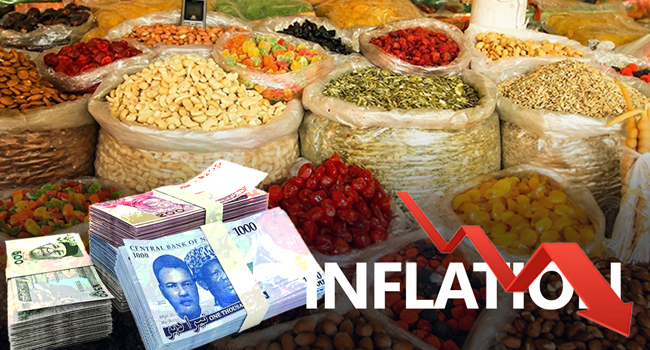












Nigeria’s headline inflation rate fell to 15.43 per cent in July 2026 from 15.91 per cent in June, according to the latest Consumer Price Index (CPI) report released by the National Bureau of Statistics (NBS) on Monday.
The bureau said the July figure represented a 0.48 percentage-point decline from the previous month.
“On a month-on-month basis, the headline inflation rate in July 2026 was 1.57 per cent, which was 0.09 per cent lower than the rate recorded in June 2026 (1.66 per cent),” the NBS said.
It explained that the decline meant the average price level increased at a slower pace in July than in June.
Despite the decline in headline inflation, food inflation continued to exert pressure on consumers, rising to 20.31 per cent year-on-year in July 2026.
The NBS attributed the increase to higher prices of commodities including rice, water yam and plantain, among others.
On a month-on-month basis, food inflation stood at 5.56 per cent in July, representing a 1.82 percentage-point increase from 3.75 per cent recorded in June.
The bureau said the monthly increase was driven by changes in the prices of crayfish, fresh pepper, onions, carrots, rice, water yam, tomatoes, garri, plantain, beef, eggs, guinea corn, ginger and plantain flour, among other food items.
Food inflation was highest month-on-month in Adamawa at 17.02 per cent, followed by Lagos at 13.48 per cent and Borno at 13.26 per cent.
Meanwhile, Jigawa, Kebbi and Bauchi recorded declines of 3.68 per cent, 3.67 per cent and 1.85 per cent respectively.
On a year-on-year basis, Adamawa recorded the highest food inflation rate at 51.36 per cent, followed by Katsina at 30.84 per cent and Zamfara at 30.65 per cent.
Borno recorded the slowest year-on-year increase, at -0.31 per cent, followed by Nasarawa at 6.88 per cent and Kebbi at 12.50 per cent.
The latest figures indicate that while overall inflationary pressure eased slightly in July, food prices continued to pose significant pressure on household spending across several states.