













At least 18 people have died as thousands of migrants crossed overnight from Morocco into Spain’s North African enclave of Ceuta, triggering one of the largest migration crises at the country’s border in recent years.
Spanish Prime Minister Pedro Sánchez arrived in Ceuta on Friday alongside Interior Minister Fernando Grande-Marlaska to oversee the government’s response as the influx continued.
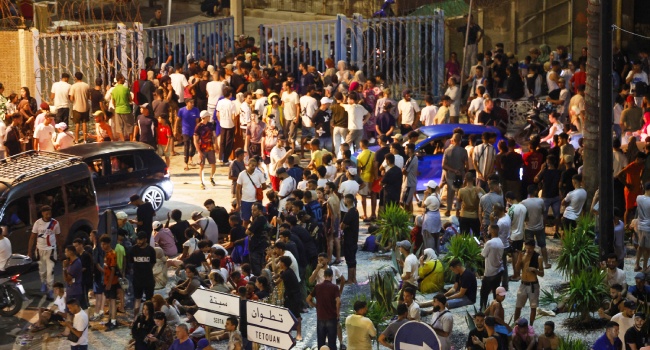
According to a police source, about 40,000 migrants have entered the enclave in recent days, many swimming around the border fence that extends into the Mediterranean Sea.
The unprecedented surge has placed Spain under mounting pressure, prompting Madrid to deploy additional troops, police officers, divers, drones and patrol boats to reinforce security in the enclave.
During the prime minister’s visit to the Tarajal border crossing, hundreds of migrants—including men, women and children—were seen reaching Ceuta by swimming around the border barrier, abandoning flotation devices and clothing used during the dangerous journey.
While many migrants continued to arrive on Friday, others began returning to Morocco, saying the enclave had become overcrowded.
“There was a steady stream of people all night long,” the police source said, adding that migrants “continued to arrive overnight and are still arriving” on Friday morning.
Authorities confirmed that at least 18 people lost their lives attempting the crossing.
The reason behind the latest surge has not been officially established. However, analysts have drawn comparisons with the 2021 migration crisis, when thousands entered Ceuta after Morocco relaxed border controls during a diplomatic dispute with Spain.
The latest developments have also sparked diplomatic tensions across Europe.
Italy has called for Spain to be suspended from the Schengen free-travel zone, prompting Madrid to summon Italy’s ambassador and accuse Rome of exploiting the crisis for political purposes.
Finland backed Italy’s position on Friday, while French Interior Minister Laurent Nuñez announced that France had strengthened checks along its border with Spain.
The situation has also attracted attention in the United States, where senior officials in President Donald Trump’s administration referenced footage from Ceuta while reiterating their anti-immigration stance.
Ceuta, along with the Spanish enclave of Melilla, represents Europe’s only two land borders with Africa.
As migrants poured into the territory, many celebrated their arrival by thanking Spanish police officers and chanting, “Bye bye Morocco, hello Spain.” Security personnel largely focused on directing the new arrivals to the local migrant reception centre.
Moroccan authorities have yet to issue an official statement on the latest crossings. However, a Moroccan official, speaking anonymously, confirmed that Rabat and Madrid had discussed the situation.
The current crisis echoes events in May 2021, when more than 10,000 migrants crossed into Ceuta within two days after Morocco eased border controls during a diplomatic dispute triggered by Spain’s decision to provide medical treatment to the leader of the Polisario Front, the Sahrawi independence movement.
The diplomatic standoff ended in 2022 after Spain abandoned its long-standing neutral position and endorsed Morocco’s autonomy plan for Western Sahara, a move that strained relations with Algeria, a key supporter of the Polisario Front.
Relations between Madrid and Algiers have since begun to improve, with Prime Minister Sánchez visiting Algeria on July 20 in the first visit by a Spanish head of government in four years.
![[UPDATED] 18 Dead as Thousands of Migrants Cross Into Spain’s North African Enclave](https://skypenewsnaija.com.ng/wp-content/uploads/2026/07/IMG_7701-150x150.jpeg)
![[UPDATED] 18 Dead as Thousands of Migrants Cross Into Spain’s North African Enclave](https://skypenewsnaija.com.ng/wp-content/uploads/2026/07/IMG_7676-150x150.webp)